Electronics II · Archive
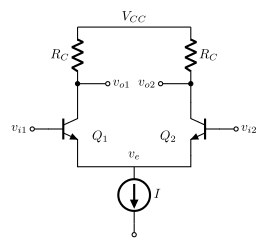
If in the circuit of Figure 10–2 we have \(v_{i1}=40\sin(\omega t)\,\text{mV}\) and \(v_{i2}=-40\sin(\omega t)\,\text{mV}\), find \(v_{o1}\), \(v_{o2}\), \(v_{o1}-v_{o2}\), and the differential gain of the circuit. Repeat the problem for the case where \(v_{i1}=v_{i2}\).
Show solution
Solution
In this case, the input is purely differential and \(v_e=0\). Thus, \(v_{be1}=v_{i1}\) and \(v_{be2}=v_{i2}\).
\[v_{o1}=-160v_{i1}=-6.4\sin(\omega t)\,\text{V}\]
\[v_{o2}=-160v_{i2}=+6.4\sin(\omega t)\,\text{V}\]
Therefore, for the requested differential output:
\[v_{o1}-v_{o2}=-12.8\sin(\omega t)\,\text{V}\]
The differential gain of the circuit is:
\[A_d=\frac{v_{o2}-v_{o1}}{v_{i1}-v_{i2}}=\frac{12.8\sin(\omega t)\,\text{V}}{80\sin(\omega t)\,\text{mV}}=160\]
When \(v_{i1}=v_{i2}\), we have \(v_e=v_{i1}\). Thus, \(v_{be1}=v_{be2}=0\), so \(v_{o1}=v_{o2}=0\). The differential gain of the circuit remains \(A_d=160\).